.jpg) | |
| Abbreviation | PSC |
|---|---|
| Formation | 1937 |
| Headquarters | Vancouver, British Columbia |
| Location |
|
Region served
| Canada and the United States |
Chair
| Susan Farlinger |
| Website http://www.psc.org/index.htm | |
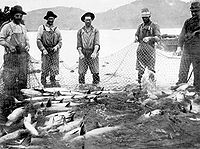
The Pacific Salmon Commission is a regulatory body run jointly by the Canadian and United States governments. Its mandate is to protect stocks of the five species of Pacific salmon. Its precursor was the International Pacific Salmon Fisheries Commission, which operated from 1937 to 1985. The PSC enforces the Pacific Salmon Treaty, ratified by Canada and the U.S. in 1985

We at the Pacific Salmon Think Tank are dedicated to helping people reach their goals just like the salmon do when they migrate up stream to spawn where they were born.
Then Pacific Salmon Commission https://en.wikipedia.org/wiki/Pacific_Salmon_Commission is http://gaalliance.org/ http://bcsalmonfarmers.ca/events/farm-tours/
Salmon conservation
From Wikipedia, the free encyclopedia

The survival of wild salmon relies heavily on them having suitable habitat for spawning and rearing of their young.[1] This habitat is the main concern for conservationists everywhere. Salmon habitat can be degraded by many different factors including land development, timber harvest, or resource extraction.[2] These threats bring about the traditional methods of protecting the salmon, but a new movement aims to protect the habitats before they require protection.History of salmon decline
Wild salmon in California, Oregon, Washington, Idaho, and southern British Columbia have been on a 160+ year downward trend and are now at very low levels.[3] Efforts to reverse the decline have been extensive and expensive, but have not met with much success.
Salmon in the lower 48 states are well on their way to attaining the status enjoyed by some other notable species — wolves, condors, grizzlies, bison — wild animals that are unlikely to disappear entirely, but struggle to survive as remnants of once flourishing species in small portions of their original range.[4] In California, Oregon, Idaho, Washington, and southern British Columbia, many runs are reduced to less than 10% of their historical numbers; some have disappeared. Many salmon runs are dominated by hatchery-bred fish. In the Columbia River, once one of the largest salmon-producers, over 80% of the total run is now hatchery-bred fish.[3]
The pattern of salmon decline is not unique to western North America. Of the Earth's four regions where salmon runs occurred historically (Asian Far East, Atlantic Europe, eastern North America, and western North America), it appears probable that salmon runs in California, Oregon, Washington, Idaho, and southern British Columbia, without a dramatic change in current and long-term trends, will emulate the other three: extirpated or much reduced runs. Since the late 1840s, an array of factors has caused the decline and a plethora of specific impediments has prevented their recovery. Throughout the region, many wild salmon stocks (a group of interbreeding individuals that is roughly equivalent to a "population") have declined and some have disappeared.
The status of salmon along the west coast of North America is not uniform. Some wild salmon and habitat restoration possibilities are better than others. There are still relatively healthy runs of wild salmon (and habitat) in some locations such as the coastal watersheds of Northern California, Oregon, Washington, and some areas of southern British Columbia. Runs in northern British Columbia, Yukon, and Alaska are in much better condition.
